Recognize the arrival
Who is approaching, which pickup group do they represent, and where are they in the physical line?
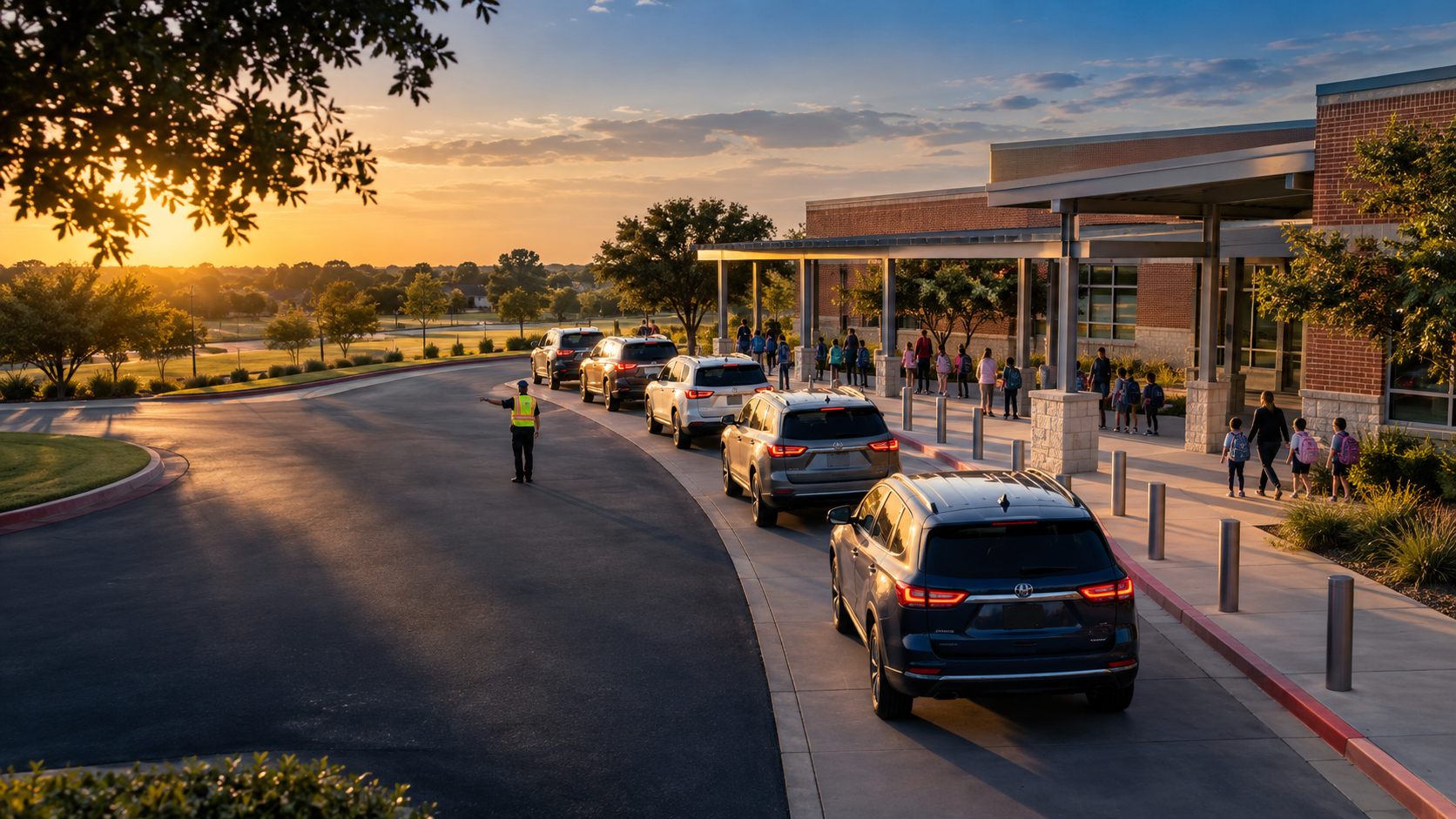
School dismissal, understood
CarLine Management looks at the whole dismissal system - the vehicles, the children, the staff, the exceptions, and the physical space - to understand where time and attention are actually being lost.
Cars arrive in a concentrated rush, often before children can be prepared.
A name being called does not mean a young child is found, packed, and ready.
Queue order can change between recognition and the actual loading space.
Backpacks, siblings, doors, and seat belts still take the time safety requires.
More than a queue
Most car lines are managed through practiced staff judgment, placards, radios, phones, gestures, and memory. That can work remarkably well - until one child is missing, one car changes order, one employee is absent, or one exception absorbs everyone’s attention.
Who is approaching, which pickup group do they represent, and where are they in the physical line?
Which children are present, leaving by car, and authorized for this pickup right now?
Locate the child, gather belongings, join siblings or carpools, and reach the right place calmly.
Match the real vehicle and position, load safely, secure everyone, and release traffic.
Where the minutes go
A car cannot leave just because somebody recognized it. The useful question is how much time exists between recognizing the vehicle and its arrival at the curb - and how much of that time the child actually needs.
Time until the vehicle reaches the curb
changes with queue movement and scan location.
Time to make the child ready
includes communication, reaction, belongings, siblings, and walking.
Why “easy” fixes fail
Grandparents. Carpools. Split households. Early checkouts. Forgotten placards. After-school activities. A child who needs more time. A car that leaves the line. Rain at 3:05. These are ordinary dismissal conditions, not rare edge cases.
If vehicles cannot pass, one slow load can hold every marked position. Software cannot create a second lane.
Recognizing a car upstream creates more notice, but merges and lane changes can make its final position uncertain.
A familiar vehicle or valid pass is not unconditional authority. Attendance, custody, and dismissal status must still control release.
A disconnected device cannot enforce a change it never received. Safe fallback requires people and procedure, not wishful architecture.
Every screen, tap, alert, and correction competes with watching children, vehicles, and pedestrian movement.
Calling children earlier may shorten car dwell while adding child waiting, teacher interruption, crowding, and supervision.
You may recognize this
A disciplined starting point
The right answer might be better information. It might be a procedural change, a different loading pattern, an existing service, or no change at all. A credible improvement begins by finding the constraint - not by arriving with a favorite technology.
Leadership, curb staff, teachers, office staff, and families do not experience the same problem or absorb the same cost.
Map traffic, child movement, physical order, staff roles, exceptions, and the manual knowledge holding it together.
Separate recognition, communication, readiness, walking, loading, blocking, and fallback time instead of relying on one average.
Establish what any intervention could actually improve before promising a result the site cannot physically deliver.
If a change is justified, prove the smallest safe mechanism in shadow mode before it influences a live child handoff.
Built around school reality
A car-line improvement has to respect the budget, the people already doing the work, and the consequences of one highly visible failure. Sophistication is not the goal. Safe, measurable, supportable improvement is.
Compare notes
The line length is visible. The reason behind it usually is not. A useful conversation starts with what your school, staff, children, and families are actually experiencing.